Turtle Boil

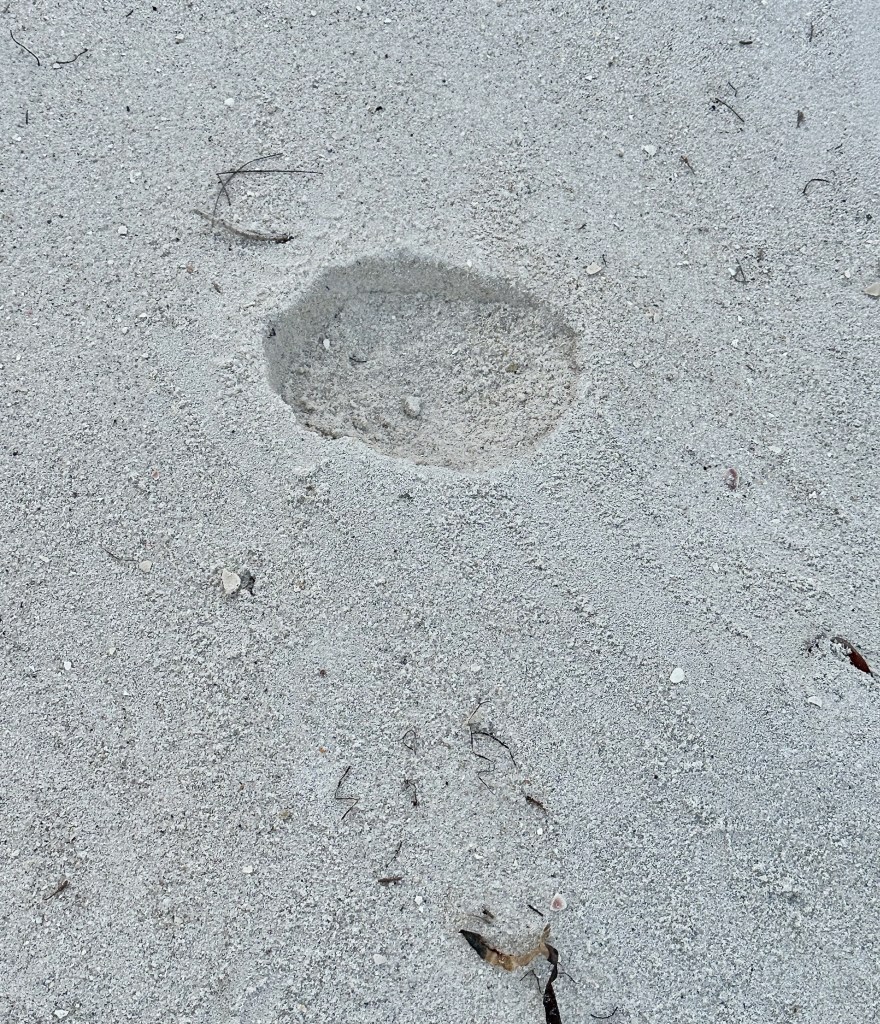
Speaking of testudines, on my beach walk yesterday morning I came across the turtle patrol. Noticing they were parked, and ever curious, I walked toward a nearby marked sea turtle nest.

Peering carefully over the markers, I noted a caved in area and tiny scratch marks in the sand around it. After roughly 100 days of incubation, sea turtle hatchlings leave their eggs, emerge from the sand*, and, typically, make their way to the water.

Unfortunately, some of these littles had been found in the backyard of a nearby house. So, the turtle patrol staff were searching the yard to make sure they’d all been found and relocated in the correct direction.

Sadly, I didn’t get to see the hatchlings clambering out of the soil. But it made me happy to know that at least one of our sea turtle nests was successful this year (since we’d lost all our nests last summer to storms).

*This mass emergence is the reason it is referred to as a “turtle boil”.

Helping Hand

While I was out exploring earlier this week I spotted an odd lump on the road. At first I dismissed it as a pinecone but that didn’t seem quite right as I drove by. So I backed up to get a closer look.

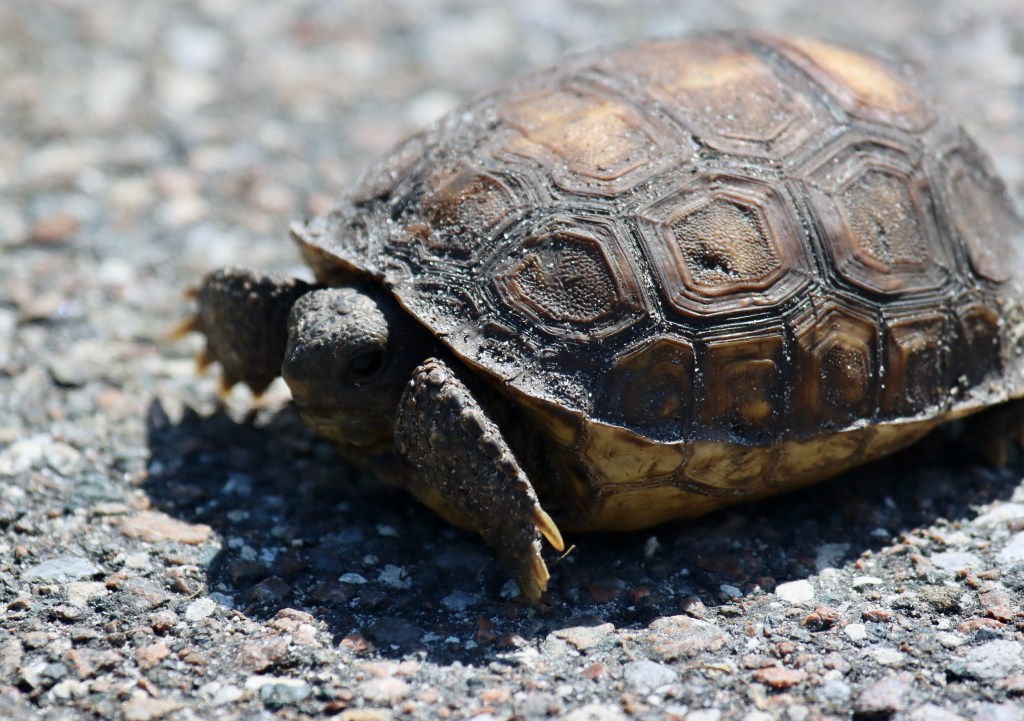
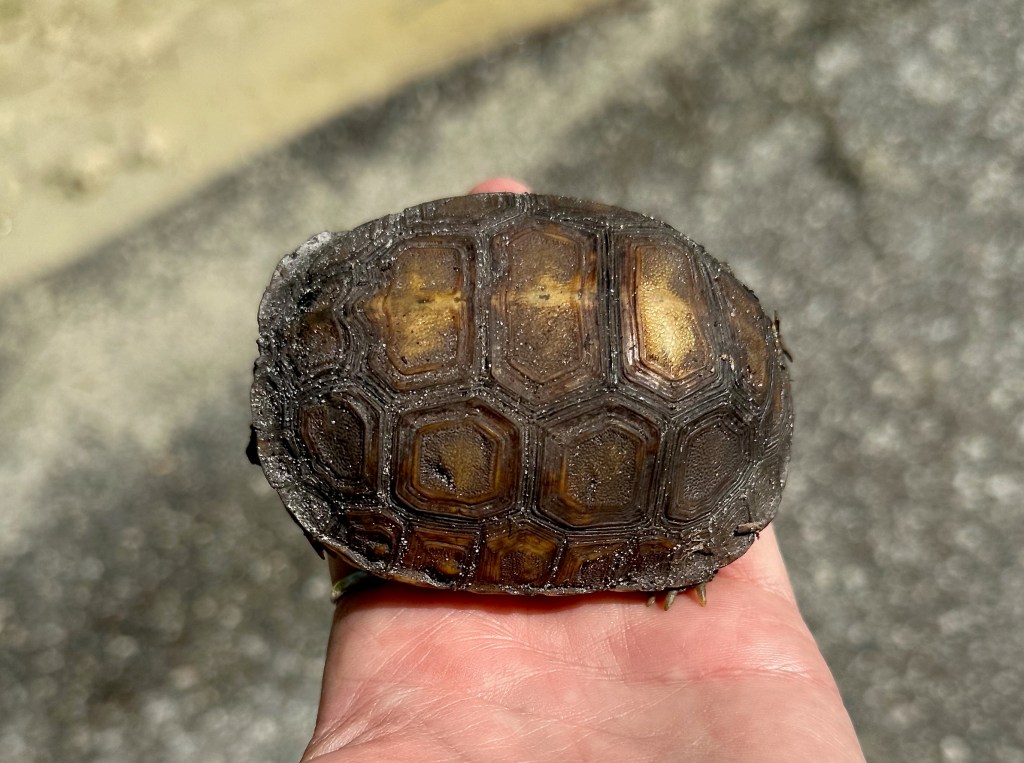
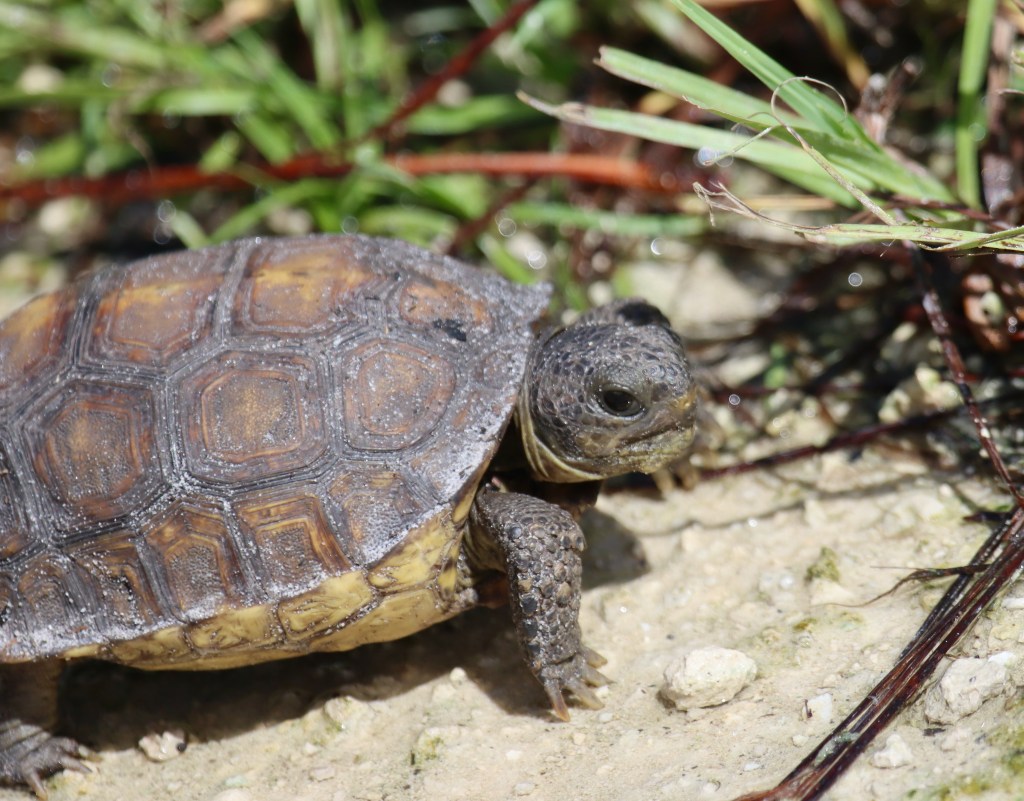
That brownish lump turned out to be the smallest Gopher Tortoise (Gopherus polyphemus) I’ve ever seen. Knowing that they are a threatened species here in Florida (mainly due to habitat loss), I decided to help the little one out.

I certainly didn’t want a careless driver to run it over so I gently picked it up off the hot asphalt.* I carried it off the roadway, following the direction it had been pointed in. While the tortoise remained tightly tucked in during the transfer process, once on the ground it didn’t take long for the legs and head to emerge. Within seconds the wee one was walking into the nearby grassland.

Having noted a bite mark on its shell, I wished it well on its journey before continuing on mine. Good luck, little dude!
* I grew up in the Sonoran Desert with a very similar species, the Desert Tortoise (Gopherus agassizii), so I am acquainted with the protocol for carefully moving these creatures.

Well, Hello

Though I often find these vivid rufous, orange shells on the beach, this was my first time finding one that was still inhabited. Despite their bellicose name, the Florida Fighting Conch (Strombus alatus) is a peaceable herbivore that poses no threat to humans. They are territorial however, with the males known to forcibly defend their personal space (hence their common name).

See those distinctive indentations (stromboid notches) near the lower, open end of the shell? Those are for the sea-snail’s eyestalks, which they periscope up so they can safely see around them (pretty cool feature).

Since I found this one in the sand near the high tide line, I picked it up and carried it back down into the water. Hopefully, we stayed within its territory, I wouldn’t want to have been the cause of an altercation!
Fond Farewell

Sadly, my dear friend Rich passed away last week. A bit of a showman, he sandwiched the event in between his recent 60th wedding anniversary and his birthday (this coming Wednesday).

I first met Rich and his amazing wife, Karen back in 2006 when they volunteered at Boyce Thompson Arboretum (the state park where I worked). I was thrilled to have their cheerful assistance, with even the strangest of projects, and there were plenty of those.

A hard worker, Rich took all my odd requests in stride. Once he stood for hours at a grinding wheel, smoothing away sharp edges on 1200 copper samples so I could give them to school children on field trips. I can’t say he was thrilled about it but he did it for the children.

Rich also had mischievous side. After studying background material, he led history tours of the park, pointing out unique features. I tagged along one afternoon and caught this tidbit, “See that rock formation over there? It’s 18 million years and 26 days old! How do I know that? Simple, they told me it was 18 million years old 26 days ago.” That got a good chuckle.

Even though we went our separate ways shortly after that, it was the beginning of a long friendship. Rich and Karen taught my then-husband and I important tips for successful RV living. A year later we caught up with them at their next volunteer gig in California.

When Rich and I drug our spouses along to a nearby tourmaline mine, we made a deal. He’d buy the bucket of tailings if I agreed to sort through it. It was a week before we had time to work on the bucket. We didn’t have high hopes but right away I found some colorful stones, almost too colorful. I looked up and saw that impish grin and knew I’d been had – he’d salted the bucket with little gems he’d bought online! Hysterical.

While visiting Rich and Karen at Galveston Island State Park in Texas, Rich taught me how to catch blue crabs with a chicken leg and string. We also metal detected on the beach, hoping to strike it rich by discovering pirate treasure (we came up empty-handed and it was cold but we had a great time).

The following year we popped in at Petrified Forest National Park where Rich led us on a behind the scenes hike to look for fossils. It was hot, and it almost killed me not to take anything for my collection, but absolutely fascinating.

After they settled in a cabin in Payson, Arizona we made it a point to visit at least once a year. Though Rich encouraged us to come more often so that he could have some “company food”. Implying that he never had anything good to eat and was suffering greatly. An exasperated Karen (who is an excellent cook) would roll her eyes and sigh, “Poor Richard!” It became our long-running joke.

A few years ago they moved to rural Virgina to help their daughter Kim achieve her dream of owning a flower farm and art collective. There were trees and shrubs to plant, fields to plow, meadows to mow, trails to hack in the overgrown woods, beavers in the pond to outwit, sculptures to install on the grounds, and numerous other tasks.

It got to the point where he’d threaten to leave the room when Kim would say, “I have an idea…” Though he might grumble, Rich always pitched in to help make it happen. Working a full half-day at a time (happy hour got a little bit earlier in the day over the years).

Rich and I shared a penchant for wanting to know what’s around the bend and I will miss our adventures. I know I will not be alone in missing him and his sense of humor. Mostly I’ll miss his big heart. He might have sounded gruff and cantankerous at times but he was always willing to help the people he cared about.

Happy trails, Rich, I hope you’re getting plenty of “company food”!

West Coast Visit

For the last part of my trip, Lisa and I headed out to the central Oregon coast. We exchanged the hot, dry sunshine of Portland for the cool, cloudy (and foggy) beaches of Neskowin and Lincoln City.

It was wonderful to revisit the place I lived back in 2018. I was fortunate to spend a lovely evening catching up with my old LC friends (sadly, I was having too much of a good time and completely neglected to take any photos).

As much as I enjoyed visiting the coast, it made me wonder how on earth I managed to survive living there- I was cold the entire time! The high was in the low 60s, a good 30 degrees cooler than what I’m currently accustomed to! 🥶

No matter the weather, it’s a beautiful place that will always have a special place in my heart.

Assisting a Mole Crab

First Full Day

It was a wonderful, sunny first day in Portland. Lisa and I spent the morning wandering nearby forested trails, stopping to smell the flowers and sample the various fruits we encountered along the way (not pictured: blackberries, blueberries, and figs).

We capped off the warm summer day with an outdoor concert by the Avett Brothers out at Edgefield. The historic property, built in 1911 as the county poor farm, went through several iterations before it was purchased by the McMenamin brothers in 1990. They restored many of the buildings, turning the old dormitory into an artsy hotel, while adding restaurants, pubs, a wine bar, movie theater, and even a golf course to the 74-acre property.

We had almost 14 hours of daylight and I think we made the most of them. Something this street art we encountered along the way reinforced.