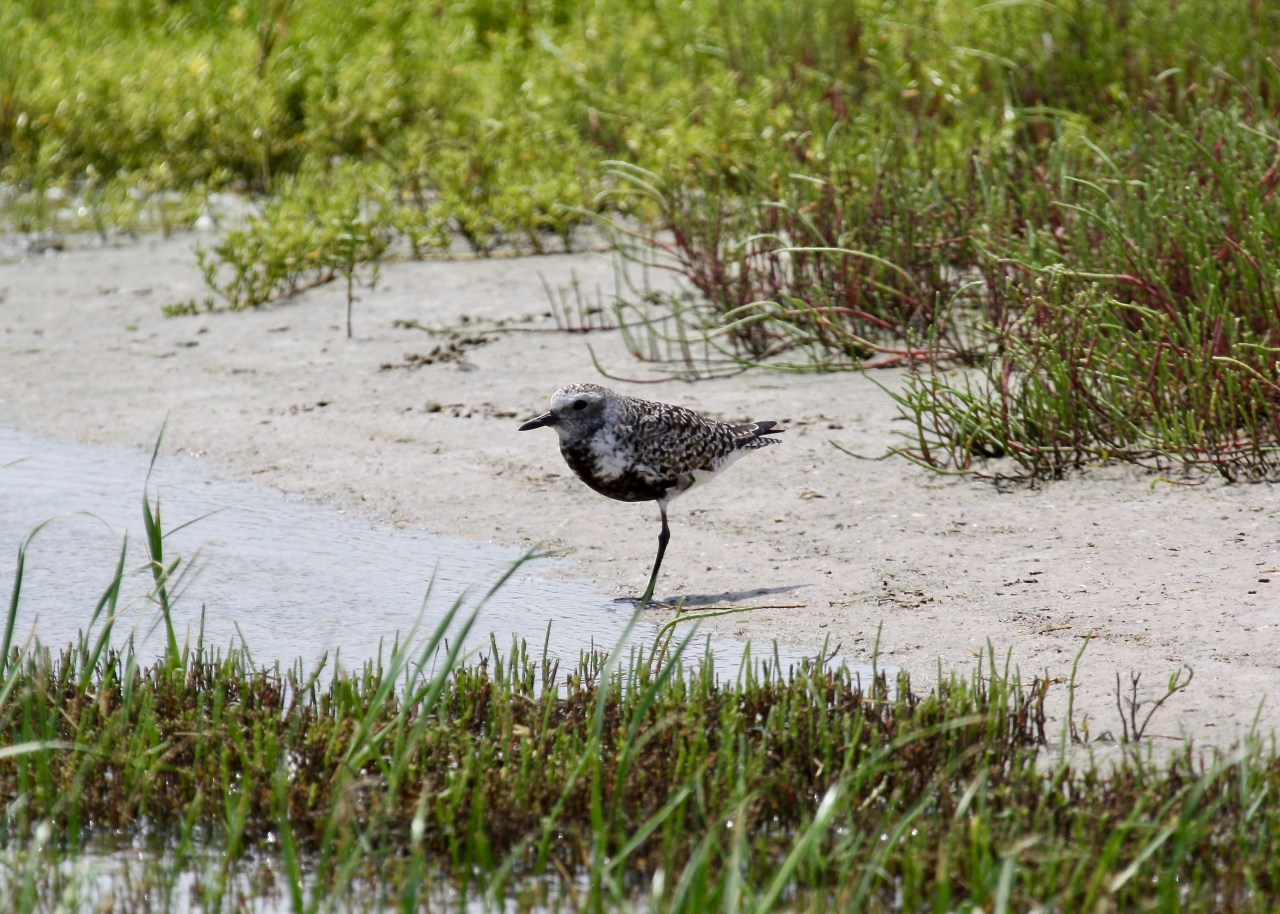
This Green Heron (Butorides virescens) was a talkative fellow, with lots of throaty kyowing going on as he attempted to entice a female. While I found him quite handsome, we weren’t exactly birds of a feather (if you know what I mean). By the way, virescens is Latin for greenish referring to the color of the crown and back (which in my photos looks more gray than green).
A Fish Tale
While waiting for a beer at the Back Porch in Port Aransas the other evening I caught this conversation between the group of men standing next to me:
Guy 1: “Hey man, how ya doing? I haven’t seen you since our fishing trip!”
Guy 2: “Yeah, that was such a great trip!”
Guy 3: “Wait, wasn’t that the trip where you forgot the tackle?”
Guy 1: “Yep. We got all the way out there and set up the poles before we realized that we left the tackle and the bait in the truck.”
Guy 2: “We had the coolers though, so it all worked out.”
Chuckling ensued…

Sunny Afternoon, South Padre Island, Texas April 2019
Prickly, Bristly
I’m pretty sure these are Bull Thistles (Cirsium horridulum) but I did not take all the photos necessary for proper identification (sorry, Julie, I know you trained me better). I was too infatuated with the showy blossoms to worry about the rest of the plants. Horridulum, appropriately, is Latin for prickly or bristly. Bees and small flies seemed to share my enthusiasm for these pretty poofs. Besides, I like saying Bull Thistle (it might just be my new swear, in my long-overdue attempt to clean up my flowery language).
Commensalism

Cattle Egret and Cow, Lamar, Texas April 2019
For the past few weeks I’ve been trying to get a decent photo of a flock of Cattle Egrets (Bubulcus ibis) that frequent a nearby cow pasture. Luck was with me the other day, when this sweet mama grazed close to the fence bringing her companion with her. Appropriately, bubulcus is Latin for herdsman. As both names imply, Cattle Egrets follow herds of grazing animals.
In a mutually beneficial arrangement, the birds snap up delicious insects that the ungulates attract (and that their large hooves flush). As you can see from the rufous highlights, it is breeding season (otherwise, it would sport only white feathers).
Paying Off
My beachcombing career really started reaping rewards this week. Literally:

Beach Comb
Figuratively:

Fishing Lure, Bracelet, $.41
And don’t forget the little gifts that artists leave behind for me to find:

Shark!
The downside to strolling the beach every day; sand everywhere. I am constantly finding sand in the most unusual places (no comment). And yes, I can feel your sympathy for me all the way over here…
My Favorite Road Sign, Ever

Texas has a vast network of Historical Signs posted along every roadway. As you probably know, I typically whip off the road to read these. However, I’ll be honest, most of the ones here in Texas have been so filled with hyperlocal minutia that I’ve been weaned off my habit. I give major props to the highway workers responsible for this sign! And no, though I (safely) flipped a U-turn on the highway in order to snap a photo of this sign, I did not stop to read the actual marker.
Primping
I watched this Black-bellied Whistling Duck (Dendrocygna autumnalis) pair take turns bathing. One stayed on alert while the other splashed and then they switched roles. Reassuring to know that your lifelong partner has your back. Plus, you want to be sure to look your best for your close-up.

And yes, they do whistle, primarily while flying (though personally, I think they sound more like a dog’s squeaky toy).
Bad Luck?

Salt Marsh Moth, South Padre Island, Texas March 2019
This Salt Marsh Moth (Estigmene acrea) certainly caught my eye. What a showy (and fuzzy) creature. According to some cultures, a white moth is a symbol of illness or death. Good thing I’m not that superstitious (she says as she rubs her lucky horseshoe). Oh, and yes, true to its name, I found it on a branch next to an estuary.
Birds Do It…
The Common Gallinule (Gallinula galeata), as the name implies is a common, though often secretive, bird in the rail family. A couple weeks ago, I was privileged to watch the entire mating ritual. After a bath, the male approached the female. She must’ve found him agreeable as she presented her backside to him. Foreplay consisted of a couple gentle strokes with his toes (possibly to help expose her cloaca). Then he mounted her, holding her neck firmly before dismounting less than 30 seconds later. Mission accomplished, she swam away while he started feeding.
Sunbathing

This Texas Spiny Softshell turtle (Apalone spinifera emoryi) was taking full advantage of the sunshine at the South Padre Island Birding and Nature Center. While preferring to lounge in fresh water, these turtles sunbathe not only to warm up but to reduce ectoparasites.