Archive for ‘Nature Notes’

Landscaping Help…

I have a family of Harris’s Antelope Squirrels (Ammospermophilus harrisii) at my house. I enjoy watching them as they scamper, bounce, and climb their way through my front yard. They seem to appreciate that I’ve worked hard over the past 7 years to re-vegetate the area with native plants. They are quite comfortable here – finding all the food, shelter, and water that they need.

In return for providing these basic necessities they give me free tree and bush trimming, soil aeration, and other landscaping help. The recent monsoon soaking revealed another of their free services – tree planting. Apparently, they have been busy squirreling away caches of palo verde seeds in my garden paths. Their food storage plan didn’t work so well since the seeds have now sprouted in thick clumps. Judging from the number of mini-forests, they’ve been busy little buggers!


One of These Things…

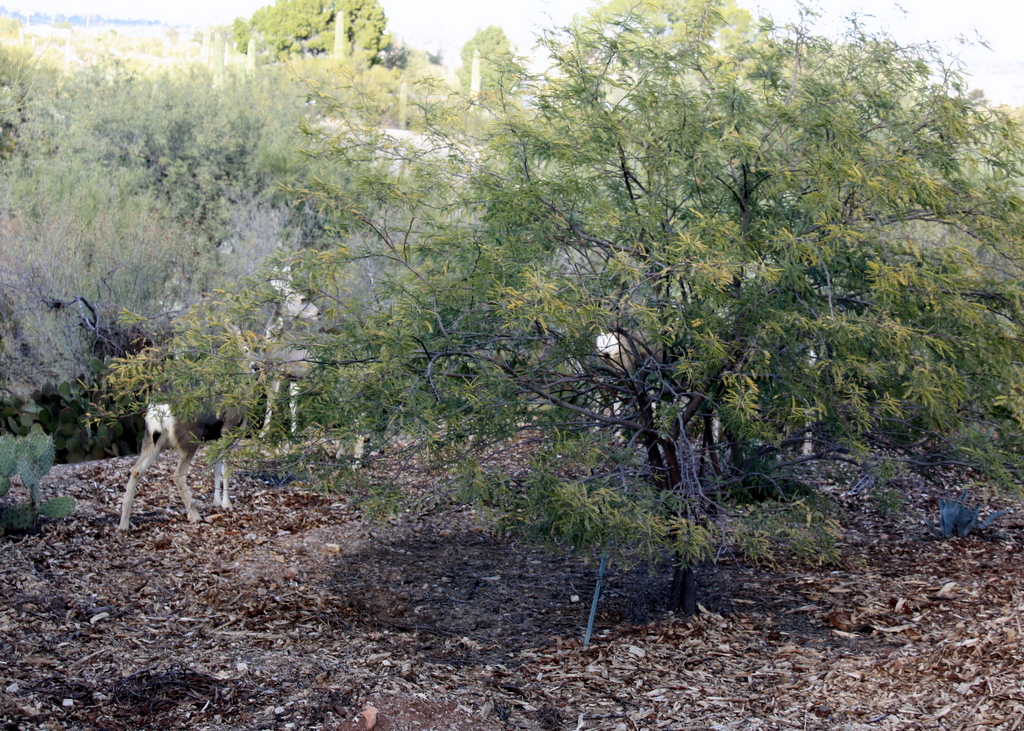
I know this situation isn’t an exact match but I now have that Sesame Street song “One of these things” in my head because of this photo from my front yard.

“One of these things is not like the others,
One of these things just doesn’t belong…”

Since I know the scale is difficult to discern, you should know that this bush is roughly 4 feet tall.

This creative feeding behavior will only be exacerbated since Southern Arizona is at least a month away from any rainfall. But I honestly don’t mind, I added many different plants to my yard in order to provide food and habitat. Besides, they are adorable!

IMG_1093


Prehistoric Human Prints Nearby

Exciting finds discovered by the team excavating the site of the new Sunset Road bridge: the oldest human footprints in the Southwest! You can read more in this article. Lucky for us, a flood covered the sets of footprints with mud preserving them. Preliminary dating suggests the adult, child, and dog were walking in their agricultural fields 2,500 to 3,000 years ago.

The archaeological survey also unearthed a more recent Hohokam settlement in the vicinity. Pima County is offering free tours of the site for the next few weeks.

If you’re interested in taking the tour, you better hurry since bridge construction commences this spring. Don’t fret about the loss of artifacts or the footprints, they will be preserved and further researched to glean more clues about these ancient Santa Cruz River Valley inhabitants.

Screen shot 2016-01-21 at 8.47.13 PM

Me, on the Radio

Here’s my recent interview on local radio promoting Beat Back Buffelgrass Day. Many thanks to Dan’s skilled editing for keeping me comprehensible. And yes, I am painfully aware that I used up my lifetime supply of the word “great.” Isn’t that just great?!

Click on the link above to go to The Weekly Green page, the audio is at the bottom of the page.

Screen shot 2016-01-18 at 8.19.33 PM


Name Our Jaguar

Once native in the United States jaguars were extirpated by hunters encouraged by federal predator policies. In 1997 the jaguar was added to the Endangered Species Act but it wasn’t until 2014 that 764,207-acres were designated protected jaguar habitat (most of that here in southern Arizona).

The handsome male jaguar pictured below, weighing in at roughly 200 pounds, was first spotted in southern Arizona in 2011. Since then he’s been caught on film over 100 times by remote trail cameras in the Santa Rita Mountains, 30 miles south of Tucson. How do they know it’s the same animal? Just like snowflakes, the pattern of each jaguar is unique.

He is one of several jaguars that have been documented over the past 20 years in Arizona. So far all of them have been males. The last known female jaguar in the U.S. was killed by a hunter in the White Mountains of northern Arizona in 1963. Which means we may never have a breeding population here in the States.

It pleases me that they still roam free. Jaguars are magnificent; powerful and intelligent creatures. And as an apex predator their survival in an area means that the ecosystem is in decent shape.

The Center for Biological Diversity is running a contest to name this jaguar as part of a campaign to raise awareness of North America’s biggest cat. Head on over and cast your vote (plus you can look through his photo album).

Credit: USFWS

Credit: USFWS