Archive for ‘Nature Notes’

Hazelnut Harvest

Oregon farmers wrapped up the fall harvest season just in time, since the winter rains returned this past week. I recently shared my experience with my first prune harvest. Unfortunately, I did not have an opportunity to be hands-on for a hazelnut harvest, but that didn’t squelch my curiosity.

My first introduction to hazelnuts was through work during my college years: the rich, nutty tortes I served at Ilsa’s Konditorei (a German bakery) and the smooth, sweet Frangelico liqueur that I mixed with coffee for guests at the Westin La Paloma Resort.

I am not much of a nut, cake, or coffee lover so it wasn’t until 1999 that I became intimately acquainted with hazelnuts. My backpacking trip through Europe that summer was akin to being thrown into the deep end of the hazelnut pool (I do believe most every confection in Europe has hazelnuts in it).

I didn’t escape hazelnuts upon my return stateside either as I visited Oregon to celebrate Lisa and Gino’s nuptials later that summer. Oregon produces 99% of the US hazelnut crop. Though at that time, most of the Oregon growers were calling them filberts (with the massive increase in hazelnut popularity Oregon has switched to the more common moniker, wisely reducing consumer confusion).

Turkey is the world’s largest producer of hazelnuts with 420 thousand tons, Italy produces less than a third of that, and the US contributes just over one quarter of Italy’s production. Though the US share is increasing rapidly. Oregon now has 70,000 acres of hazelnuts with another 8,000 acres added every year to meet rising demand.

Quick foray into the wild world of math: figure an average of 108 trees per acre x 8000 acres added each year = 864,000 trees x 25 pounds per tree = 10,800 additional tons of hazelnuts. Add in the roughly five years before trees reach peak production and the US should meet or exceed Italy’s production in about twelve years!

The near-insatiable global craving for hazelnuts can be blamed on a certain creamy spread. The creation of Nutella was the result of wartime shortages during WWII. During the war, Italian confectioner Pietro Ferrero couldn’t source enough cocoa for his bakery. So he creatively incorporated locally grown hazelnuts to stretch his cocoa. The first creation was a hard block, the creamy spread debuted in 1963, and the rest as they say, is history. Nutella is so popular that the company utilizes roughly 25% of the world’s supply of hazelnuts. 225,000 tons is a staggering amount of nuts!

There are a few reasons why growers appreciate hazelnuts: they fall from the tree and slip easily out of their husks when ripe (making them relatively easy to harvest); they have a low water budget (especially in contrast to the obscene amounts of water almonds demand); they are easy to extract from their shell; plus, each tree can drop 25 pounds and produce for at least 70 years.

On a personal level, I admire the striking-looking trees with their thick, knobby trunks as well as the striped, caramel-colored shells. Oh, and, yes I hear they are quite tasty, too!


Fall Storms

The last two days started out mild and sunny here on the Oregon Coast so I was able ramble along the beach before the storms blustered in. Both days I returned home just before the wind started throwing raindrops around.

The surf wasn’t huge but it was agitated, with medium-sized swells crashing closely together. The Surf Scoters certainly earned their name, floating over the smaller crests and dipping under the larger ones.

I never know what I might find in the wrack line after a storm. Sadly, I am finding more trash lately, primarily bits of hard plastic and plastic packaging. Based on my recent findings, I can report that Snickers has the dubious pleasure of joining Bud Light and Coca Cola in their ubiquitousness in the litter realm.

My “treasures” from the past two mornings consist of a tan plastic figurine and a green plastic container. The former, I have decided, is a beachcomber with a metal detector (most definitely not a soldier searching for landmines). The latter puzzled me until I popped it open to find two perfectly dry and intact joints. I’m sure other folks would’ve figured it out sooner but that’s not the way I roll.

Beachcombing can be a bit challenging at times; keeping one eye on the high tide line while also scanning the ocean watching for sneaker waves. October ushers in the season for these poorly understood yet deadly phenomena. In my opinion, the name is too innocuous for such a surprising onslaught of water. Killer waves would be a better fit since the “little tsunamis” on the Oregon coast average one death a year (more than any other weather hazard).

The danger is two-fold: speed and weight. Sneaker waves surprise people by rushing far up the beach before rapidly returning to the ocean. Salt water, already denser than fresh water without the added weight of floating sand, is a lethal force. A wave only four inches deep can move a five-ton driftwood log.

The guidelines are: Never turn your back on the ocean. Do not fight the current if you are swept away (try to float until the waves lead you closer to shore). Lastly, do not attempt a rescue. It doesn’t matter if it is a dog, daughter, friend, or stranger – you will be swept away as well (forcing the Coast Guard search for two bodies instead of one).

Here’s hoping I never encounter one!

Prune Pickin’

Fall is harvest season and here in Oregon, farm workers are busy plucking apples, pears, hazelnuts, wine grapes, and prunes. Note that I said prunes, not plums. Prunes (fresh or dried) come from several cultivars of freestone plums that are meatier, with less water than a typical plum.

It can be said that all prunes are plums but not all plums are prunes. This truth is muddied a bit by marketing, because starting in 2001 the FDA allowed prunes to be called ‘dried plums’.

I was fortunate to take a tour of the Elliott Farms prune orchard during harvest last month. The farm, started in 1882, is the largest in the Willamette Valley, encompassing 55,000 trees over 700 acres. Bruce Elliott is the fourth generation to oversee the land and has a very hands-on approach. During our visit, Bruce was busy wheeling racks of prunes into one of the dryers. But I’m getting ahead of myself.

Let’s start with the ripe, deep blue, elongated fruit hanging on the tree in the warm sunshine. The prune harvest season starts with Bruce and his team carefully assessing the fruit on the trees. This is delicate dance between a high enough Brix (sugar content), typically 20-24, and time. The longer the fruit is on the tree the higher the Brix. But the higher Brix means the fruit is softer which increases the chance of damage to the skin and the skin is crucial.

The tree-shaking method of harvest actually helps in this situation. A shaker enfolds the tree trunk and gently shimmies the tree for about ten seconds. Ripe fruit falls onto the tarp-like material before rolling down to the conveyor belt of the receiver tractor. Fruit that needs more ripening time remains on the tree until the next pass of the machinery in a couple weeks.

Now the real race against time begins. The fruit is hauled back from the orchard for processing. After a quick shower, prunes are sorted and placed on drying trays. The sorting crew removes any leaves or stems while small fruit falls through the mesh (this pile later returns to the orchard as mulch).

Each 3’x3′ drying tray has a single layer of prunes. Trays are stacked on a wheeled rack two dozen high. Every two hours one of the large drying tunnels is opened and twelve racks of fresh fruit are wheeled in one end, pushing twelve racks of dried fruit out the other end of the tunnel. The drying tunnels are heated to 180 degrees forcing the prunes to release roughly 100,000 gallons of water a day.

The freshly dried prunes are dumped out of their trays into holding bins to continue sweating. The prunes must be dried within 24 hours of harvest or ‘box rot’ can set in and ruin the fruit. Elliott Farms has four of the dryers so it was a whirlwind of constant motion. Watching the crew was mesmerizing. Even though they only did this for six weeks of the year, they were a well-honed system.

While prunes are much-maligned here in the States, they are a desired commodity in Europe and China. Though the overall harvest for 2018 was reported down about 25% because of water-stress, it should still be a profitable crop. In 2017, prunes fetched $1970 per dried ton (or $635 per wet ton). Oregon is a distant second to California in prune production: with over 1300-acres planted, yielding 4220 tons (according to the 2015 USDA Noncitrus Fruits and Nuts report).

Not only did I enjoy my educational tour but we were allowed to sample both fresh and dried prunes. I loved the fresh fruit, it was meaty and flavorful but much easier to eat than a plum. Let me tell you, if you’ve only had them dried you are missing out!

Clone War

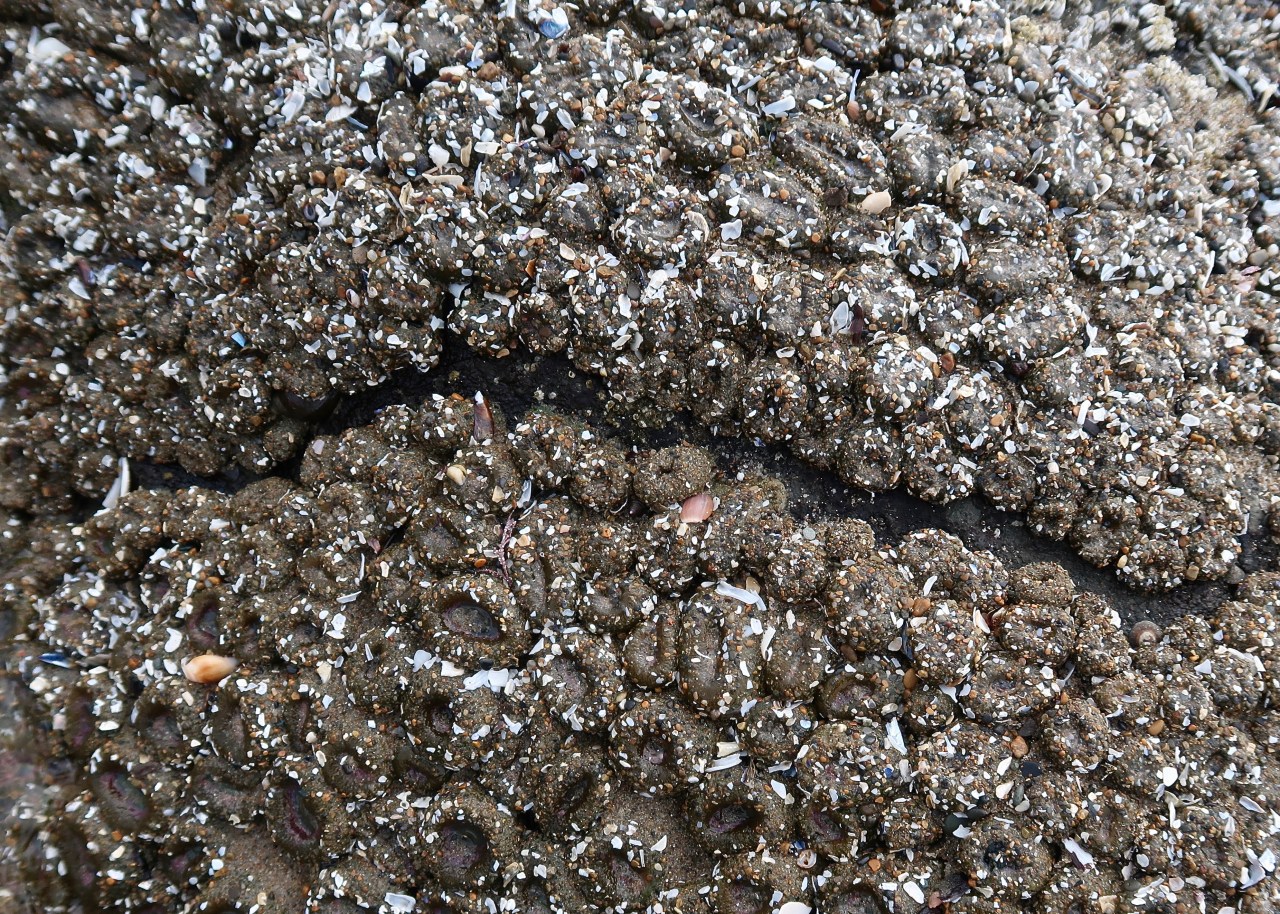
Aggregating Anemones (Anthopleura elegantissima) are amazing! (Forgive me, I couldn’t help myself, the alliteration was too tempting!) Not only do they thrive in the harsh swash zone subjected to: pounding waves, daily cycles of drying, and stomping on by unaware beachgoers. But they can also survive being covered by shifting sand for weeks at a time. Tough little globs of goo!

As if that wasn’t enough to prove their toughness, they replicate by cloning. Which means that they literally tear themselves apart to create two anemones. Each new anemone follows suit and as the name implies, the expanding clonal colony forms a dense mat of anemones across any hard substrate. Sounds like Aggregating Anemones would take over the world since they have few predators (namely one species of sea star, a nudibranch, and a sculpin).

There is one other controlling factor; war. Clonal colonies don’t tolerate different clones (not fans of genetic variation, apparently). The clones at the outer edges of a colony use their acrorhagi (specialized tentacles) to sting the “non-matching” anemone; injuring or even killing it. The visible line between the colonies is proof of the length of their acrorhagi and serves as a demilitarized zone.

So much for being simple lifeforms…


IMG_2782 (1)

Colorful Crab

Most of the crab exuvia I stumble across during my beach strolls are from Dungeness Crabs, which are commonly a dull buff color. Which is why this bright red shell attracted my attention. Fittingly, the Red Rock Crab (Cancer productus) is named for it’s bright shell. I’m glad I flipped it over to peek inside the shell, that purple is gorgeous!

What purpose does that inner splash of color serve? I can’t think of any biological reason for it. It certainly doesn’t seem necessary for the crab’s survival. Then again, I wonder, maybe all beauty is like that? Not one of the basic necessities of life but something that makes life worth living…


Mermaid’s Bladder

Walking on a different beach recently, just a few miles south of where I live, I became mesmerized by the Bullwhip Kelp (Nereocystis luetkeana) that had washed ashore. The smoothness and the golden-brown coloration of the floats (pneumatocysts) made them quite photogenic. I am clearly not the first person to be fascinated by the floats of this kelp since the name Nereocytstis is Greek for Mermaid’s Bladder.

As you know by now, once something catches my eye I am driven to dive into the subject and this was no exception. The rapid growth rate of Bullwhip Kelp is astounding enough: morphing from a single spore to 120′ long in one growing season (that’s over 5” a day). But the real story is the interconnection between this kelp, sea urchins, sea stars, and Sea Otters.

Back in March I shared information about the Sea Star Wasting Syndrome (SSWS) that caused a massive die-off of sea stars along our Pacific coast. First noted the summer of 2013, the disease has affected over 19 species of sea stars, severely depleting the population. Turns out we have more to mourn than the loss of sea stars, as entire ecosystems have been negatively impacted.

Ochre Sea Stars (Pisaster ochraceus), control California Mussel (Mytilus californianus) abundance on intertidal rocks which allows for a greater diversity of species on those valuable territories. A bit further offshore in the subtidal zone, Sunflower Sea Stars (Pycnopodia helianthoides) prey predominately on sea urchins. Since 2015 the sea urchin population has exploded, according to one researcher, “…densities have increased from less than one urchin per square meter to anywhere from a dozen to three dozen…”

Sea urchins voraciously devour algae, which includes kelp. Even Bullwhip Kelp (the fastest growing kelp in the world) can not withstand the onslaught of unrestrained masses of sea urchins. Urchin barrens now cover vast sections off the west coast where great kelp forests once thrived.

This is devastating since kelp forests not only minimize wave action but they provide sheltering habitat for a number of species, including Sea Otters. Sea Otters are inextricably linked to these kelp forests as they hunt and sleep amongst the stems and ribbons. The decline of Sea Otter populations is at least partially linked to SSWS.

There is a bright spot in this sad tale, sea star surveys conducted in the past few months have noted a huge increase in juveniles. There is even a high likelihood that these youngest sea stars are immune to SSWS. Hopefully, these nearshore ecosystems are on the road to recovery.