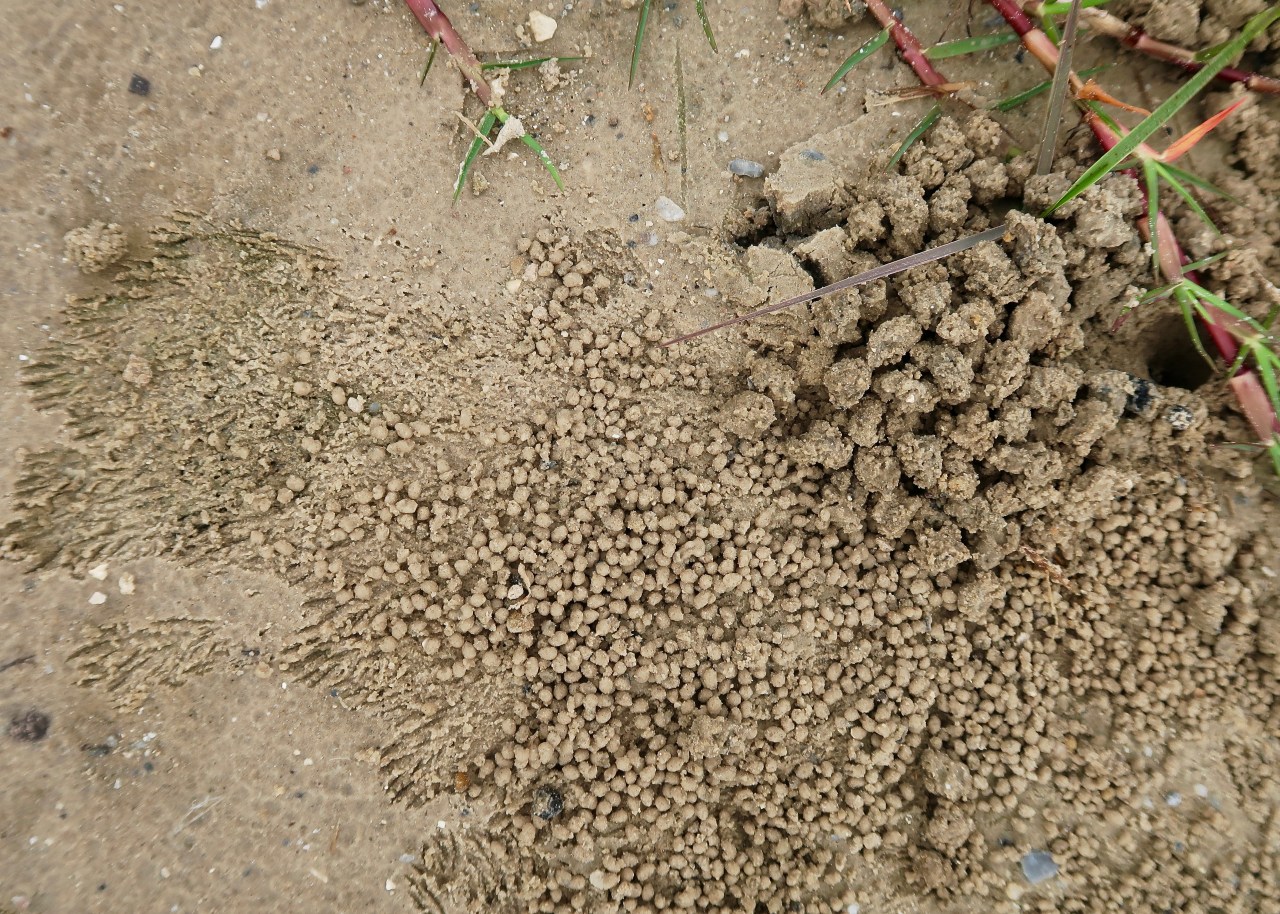
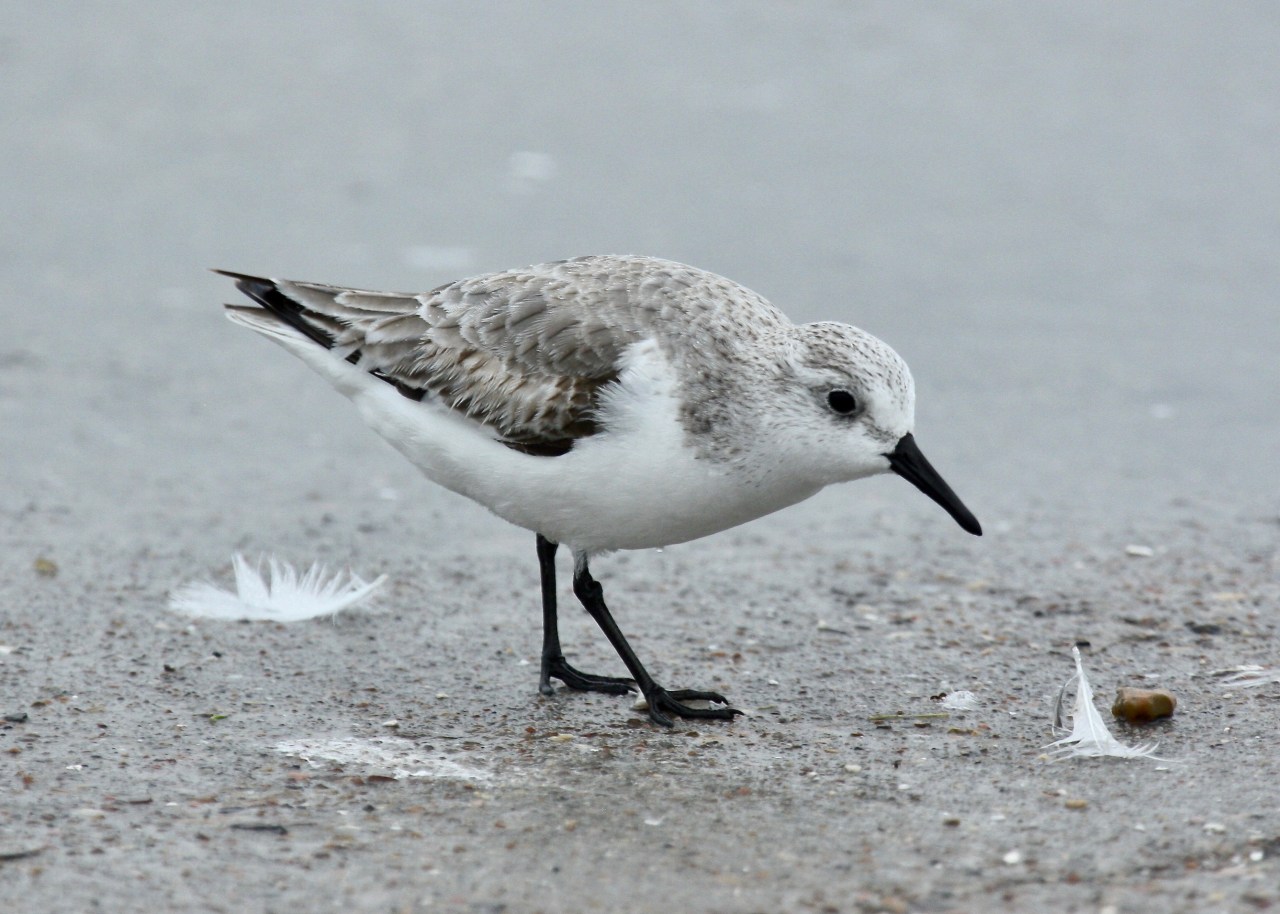
I know bird guides use those words to describe Sanderlings (their body and bill respectively) but I happen to find them adorable. If you haven’t watched it yet, check out Piper, the Pixar video about peeps that won an Oscar in 2017 for Best Animation.
Archive for ‘Observations’
Bath Time

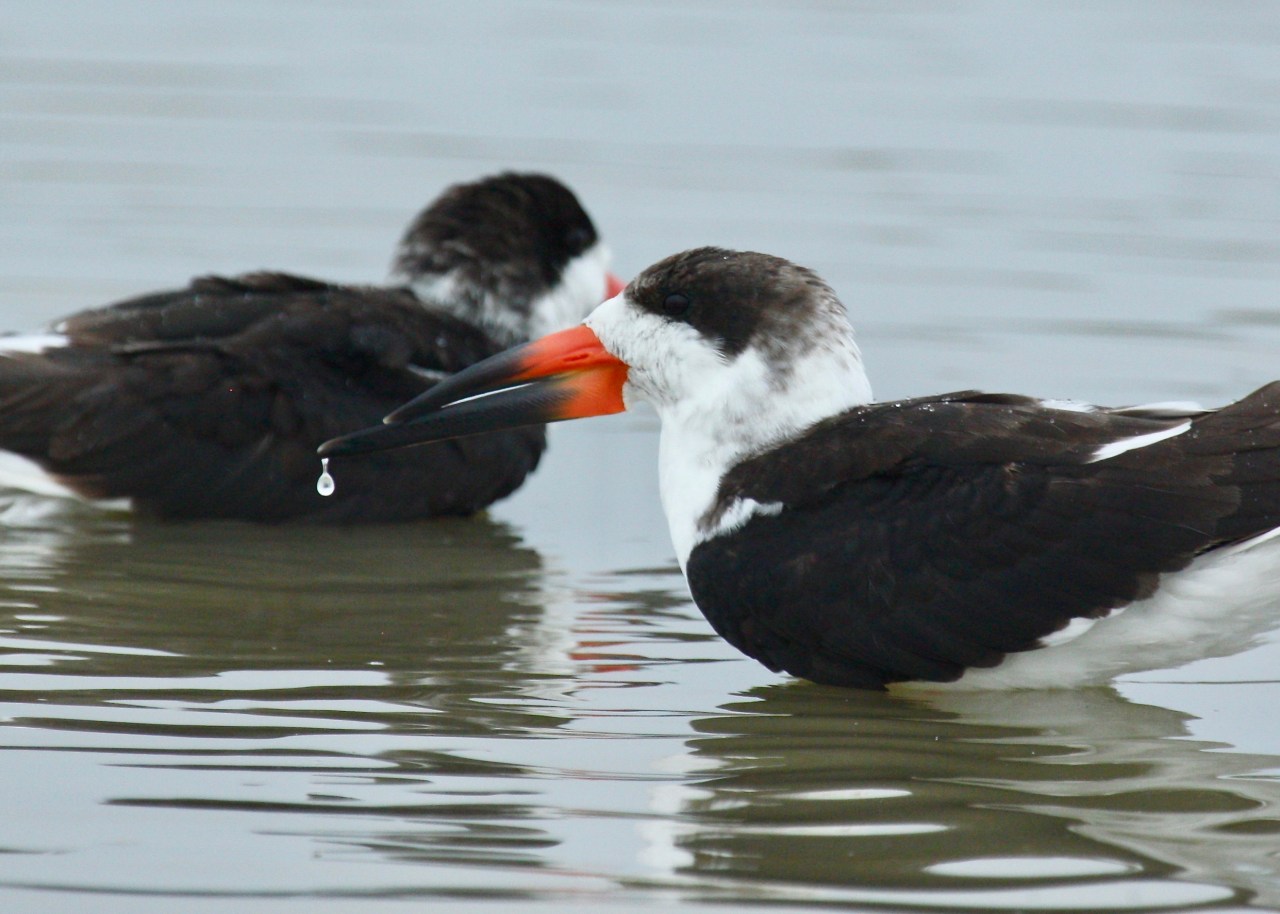
I spent an hour at Rockport Beach mesmerized by Black Skimmers bathing. Their name derives from their unique feeding method. They hunt by feel; flying low, skimming their mandibles in the water. When they touch a fish their bills snap closed. As a strategy, the percentage of success is low but hunting by feel means they can hunt at night while most other birds can’t. Read more about their distinctive qualities in this lighthearted article by Nicholas Lund.
Crabby

I found the first of what I am assured will be many Hermit Crabs here at Rockport Beach. Most likely this is one of the several Pagurus species that move into shallow water during their winter breeding season. It was the only one I saw, hopefully a mate is out there somewhere. Good luck little crustacean!
Just Beachy!

A lonely palapa at Rockport Beach this morning. Two blocks from my cottage, the park is slowly rebuilding infrastructure damaged by Hurricane Harvey in late 2017. The birds didn’t seem to mind. Next time I’ll take my big camera. Without a lot of effort I spotted these cool species today: Black Skimmer, American and Brown Pelicans, Great Egret, Cattle Egret, Great Blue Heron, Ruddy Turnstone, Long-billed Curlew, Black Vulture, and even a few Bottlenose Dolphins. Not a bad way to spend an afternoon!
Sea Fog

Though temperatures have been on the warm side, the dense sea fog rolling in has blocked out the sun the past couple days. The visibility index for the Coastal Bend was at zero this morning (meaning the average driver can only see about 330 feet ahead). On the plus side, it stopped raining!
Above Average Rainfall

Rockport ended last year way ahead of average in rainfall and started the new one the same way. The driveway to my little cottage has transmogrified into a swamp which my little car was no match for. It was reminiscent of the car stuck in the mud scene from My Cousin Vinny. (Though I don’t do Marissa Tomei’s character’s accent nearly as well as she does. Funny movie by the way!)
Thankfully, my new neighbors were nice enough to push me out of the mud. After which I imagine they went home for a good laugh while drinking sweet tea to cool off. As my intuitive friend Jeff said, “It would figure that a desert girl would get stuck in the mud.”
Hurricane Harvey Impact

Hurricane Harvey wasn’t the most damaging tropical storm to blow through Rockport (the 1919 hurricane almost wiped the town off the map) but it certainly caused significant damage here. Residents have done a remarkable job rebuilding their community in the days since landfall (August 25, 2017), though about a quarter of the population hasn’t returned due to the housing shortage. Learning that fact, I feel especially fortunate to have found a cute little cottage to rent here.
A Different Coast

For a variety of reasons, I have moved from the rugged, scenic Central Oregon Coast to the balmy, flat (but no less beautiful) Coastal Bend region of the Texas Gulf Coast. I first visited this area eleven years ago and I thoroughly enjoyed my stay. I’m looking forward to new adventures involving sea turtles, dolphins, a wide variety of birds, alligators, excellent food, and yes, even sweet tea.
Last of the Keys
I let out a small sigh as Key West receded in my rearview mirror. I enjoyed my time delving into island life, but it felt like my visit was forty years too late. Though the historic buildings are unchanged, they seem diminished in the shadows of the massive cruise ships. Though the locals are still laid-back, they are incessantly jostled by the throngs of tourists. Is it possible to be nostalgic for something I’ve only read about?
The balmy weather soon brightened my outlook. How could I be surrounded by aquamarine water and swaying palm trees and not be in a good mood? Reaching Big Pine Key I turned off to explore the National Key Deer Refuge. Established in 1957, it is one of the smaller properties in the National Wildlife Refuge system. Perhaps that is fitting since it was set aside to protect the smallest deer in North America.
The Key Deer is a subspecies of White-tailed Deer that is found only in the Florida Keys. These deer are the size of a large dog, with males topping the scale at a whopping 75 pounds. As with other species that evolve on small islands, the Key Deer shrunk in size, a process known as insular dwarfism. Another example is the Channel Islands Pygmy Mammoth, which once lived off the California coast.
As I roamed the trails I was struck by the similarities of the habitat with the Sonoran Desert one where I grew up. The plants were spaced out; there was very little overlapping vegetation; and some had thorns (or other protective mechanisms, like poisonous sap). In both places, limited fresh water was the responsible mechanism. Comparing the numbers it doesn’t seem possible. After all the Sonoran Desert around Tucson averages twelve inches of rain a year, while the Keys receive over three times that amount. The difference is that the Keys are comprised of fossilized coral reefs where there is very little substrate to retain the rainwater.
It was after noon and I relegated myself to the fact that I wouldn’t be seeing one of the refuge’s namesake animals. Determined to photograph a roadside sign before I left, I drove down a side street behind the Visitor Center. Where, lucky me, I was able to watch one of the diminutive creatures from my car.
After snapping some photos I continued north a few miles to Bahia Honda State Park. The park encompasses the spit at the southern end of Bahia Honda Key and provides excellent views of Hwy 1 as it swoops over Florida Bay as well as foot-access to a portion of the historic Florida Overseas Railroad bridge. I spent the afternoon meandering the white, sandy beach; collecting tiny shells, admiring the translucent claws of Ghost Crabs protruding from their burrows, and watching the water change color as clouds shifted beams of light across the surface. What a picturesque spot to spend the day!
I tore myself away in the late afternoon, continuing north to Islamorada, my home base for the next couple nights. The small town is the polar opposite of Key West. Quaint lodgings hailing from decades past are scattered along the highway in place of new, splashy resorts; hard-working fishing vessels ply the water in lieu of monstrous cruise ships; and sunset celebrations are the highlight of the evening with the party wrapping up by 10pm instead of just getting started. I felt instantly at ease there; it was much more my style.
Everywhere, piles of debris and other visible damage remained from Hurricane Irma which stormed through in September 2017. Islamorada is nothing if not resilient. The town was obliterated by the Labor Day hurricane of 1935. People, houses, shops, boats, and even the railroad tracks were torn from the island and scattered over a 40-mile radius by the massive cyclone.
Over 700 people died as a result, many of them WWI veterans who were in the Keys working on the Overseas Highway (a Depression-era program similar to the Civilian Conservation Corps). The rescue and recovery effort was chaotic and poorly organized. Anyone with a working boat volunteered, including Ernest Hemingway. By the third day, the Florida Health Department issued an order to cremate all bodies where they were found after attempting to identify and document them.
Henry Flagler’s precious Florida Overseas Railroad, that connected the Keys to the mainland, was never rebuilt. His $50 million investment, that took seven years to complete, operated for a mere 23 years before being literally blown out of the water. I learned more about Flagler while touring the new Keys History & Discovery Museum.
Flagler, and his business partner John D. Rockefeller, co-founded Standard Oil in 1870. Ruthless in stamping out competitors (earning them the moniker, robber barons), SO quickly expanded into a multinational corporation. Their manipulation of the market and questionable business practices ultimately led to the company’s demise. In 1909 President Theodore Roosevelt’s administration initiated a case against Standard Oil under the Sherman Antitrust Act. It culminated in 1911 with a breakup of the company after the U.S. Supreme Court ruled it was an illegal monopoly. To say Flagler was no fan of Roosevelt’s is an understatement. When told Roosevelt was going on safari, Flagler replied, “I wish the African lions good hunting.”
My last afternoon in the Keys I stopped at Robbie’s, a little marina that has grown into a popular roadside attraction by feeding tarpon. While leading fishing trips is still a part of the business, the spot has morphed into a local artisan market, restaurant, and bar. The main draw are the showy, jumping fish that tourists can feed for couple dollars. I’m glad I stopped to check it out since I finally saw my first manatee!
While the crowd was occupied on the pier I wandered over to the small dock nearby. As I stood there marveling at the hubbub across the way, a large slow-moving blob surfaced in the water. Nostrils poked out for a moment before descending below. I was thrilled! The next time it came up for air, the manatee had a dead fish in its mouth. I watched for the next half hour as my sea cow slowly gummed the flesh off the fish (the herbivorous manatees only have molars). Once again proving that no animal in nature will turn down free nutrients!
Christmas Eve was my last night in Florida and I spent it in Miami’s Little Havana. I was treated to the Cuban celebration of Noche Buena with loud music, laughter, and the smell of roasted pork wafting through the neighborhood. The evening ended with fireworks. It was a cultural experience I wasn’t expecting but what a festive way to wrap up my trip to Southern Florida!
End of the Rainbow
I reached the end of the road in Key West on a balmy December afternoon and headed straight over to the Fort Zachary Taylor Historic State Park for a little exploring. Presumably, the soldiers stationed there during its 100 years (1845-1947) suffered through some hardships but wow – what a location! After touring the fort and admiring the view I wandered over to the beach to dip my toes in the inviting Atlantic Ocean.
Ouch! The beach that looked like soft, white sand is actually comprised of small, angular chunks of decomposing fossilized coral. There is nothing soft about it! If I lived there I’m sure my feet would toughen up and get used to it. Whiling away a warm day; watching turquoise water gently lapping the shore under gently swaying palm trees – not a bad introduction to Key West.
After sunset, the music wafting over from Duval Street enticed me over to Sloppy Joe’s. It seemed fitting to hang out at the bar where Ernest Hemingway spent so much time. It was also a great place to indulge in the endlessly entertaining hobby of people watching. I lost count of all the different languages I overheard.
I didn’t even remotely try to match Hemingway’s drink count (he seemed to treat drinking like an Olympic sport). Joe Russell, the bar’s original owner and namesake, once said that Hemingway bought his house next to the Key West Lighthouse so that he could find his way home after a long night at the bar.
Thanks to the low battery alert on the smoke detector in my room I was up well before dawn the next morning. So, I was showered, breakfasted, and out the door by 7:30am. Which I discovered, in Old Town Key West, is a good two and half hours earlier than everyone else. Old Town retains much of the same anything (and everything) goes attitude that it had during Prohibition. Locals reportedly viewed Prohibition as “an amusing exercise dreamed up by the government”. Their late nights are not conducive to early mornings.
So I meandered through neighborhoods, admiring architecture, random yard art, and recognizing locations mentioned in Jimmy Buffett songs. Next time I hear “Woman Goin’ Crazy on Caroline Street” I’ll know exactly where she lived. I like picking up these tidbits of knowledge about places I’ve visited, connecting these pieces creates a clearer picture. Much like putting together a puzzle.
Needless to say I was one of the first in line at the Ernest Hemingway House. My early morning turned out to be a good thing as I was able to wander the grounds and spend time with the polydactyl cats before the crowd arrived. According to my tour guide, polydactyl (six-toed) cats were considered good luck by ship captains and it was a captain friend of Hemingway’s that gifted Snow White to him. The 56 cats currently residing on the property are all descended from Snow White.
I was pleased to see how well the cats were tended. The specially fenced property is clearly their domain and they roam freely through the house and grounds. Some of the staff even disobeyed evacuation orders during Hurricane Irma in 2017 and stayed with the cats in the home’s basement. They all survived unscathed.
I enjoyed my morning at Hemingway’s and I’m glad that it has been so well-preserved. Though I had to shake my head at the paradox of people getting married there. Yes, it is a beautiful property but I doubt Hemingway’s approach to marriage is what one wants to emulate (he was married four times and cheated on at least three of his wives).
Afterward, I crossed the street and climbed the Key West Lighthouse for a glorious bird’s-eye view of Old Town. Sadly, the tallest nearby point is Mt. Trashmore, the old landfill that dominates the skyline over on Stock Island. My day ended with another dose of toe-tapping live music, this time over at the Green Parrot.
On my final day I stopped in at Truman’s Little White House. It was built in 1890 as the First Officer’s Quarters for the Key West naval station. After WWII the building was vacated. In the fall of 1946 President Harry S. Truman’s physician recommended a relaxing vacation somewhere warm. Unsurprisingly, stepping into the presidency mid-term and wrapping up WWII had strained Truman’s health.
Since the house was not in use and securely located on a naval base it was a perfect choice. Truman and his entourage (staff, Secret Service, and reporters) arrived in November. While he may have been relaxing, Truman was not on vacation. Technological advancements kept him in close contact with Washington D.C. and documents were hand delivered every few days.
The location proved to be quite popular, Truman visited a total of eleven times during and after his presidency. General, and later, President Eisenhower also stayed in the home. President Kennedy visited in 1961 and returned right after the Cuban Missile Crisis in 1962. Though the U.S. government deeded the property to the state of Florida for use as a museum in 1987 the house is still occasionally utilized by former Presidents. Carter and his family visited in 1996, Clinton stayed here with his wife, Hilary in 2005.
Key West, the pot o’ gold at the end of the rainbow…