Archive for ‘Nature Notes’

Wee Sand Dollar

Shortly after moving to the Central Oregon Coast I was delighted to find a tiny Sand Dollar (Dendraster excentricus)*, roughly the size of a dime. It was the smallest one I had yet found…until today.

How in the world did this tiny, delicate, calcium carbonate structure survive the pounding surf, tumbling beach cobbles, and footsteps of beach combers? New treasures every day…

Today’s wee Sand Dollar, both tiny Sand Dollars.
 

*Technically, I found Sand Dollar tests (the proper term for their skeletal remains).
Today’s Treasures


Driftwood balancing act, horses on the beach, tiny Dungeness Crab, unknown fossil and Katherinella (bivalve) fossil both from the Astoria Formation (17-15 mya).

Boring Clams

During a recent beach walk a friend explained to another what made the holes in the rocks, “Boring Clams, literally.” I just couldn’t help myself, “Well, figuratively, too. If you invite them to your party, they won’t dance, they’ll just sit there. They really are boring clams!” Ba-dum-tshh!

All kidding aside, it is the Piddock or Boring Clam (Penitella penita) that uses the rough ridges on its shell to slowly grind a hole into rock where it will stay for the rest of its life. Lucky for them, most of the rock up here is a fairly malleable mudstone.

IMG_5485

Hermit of the Swash

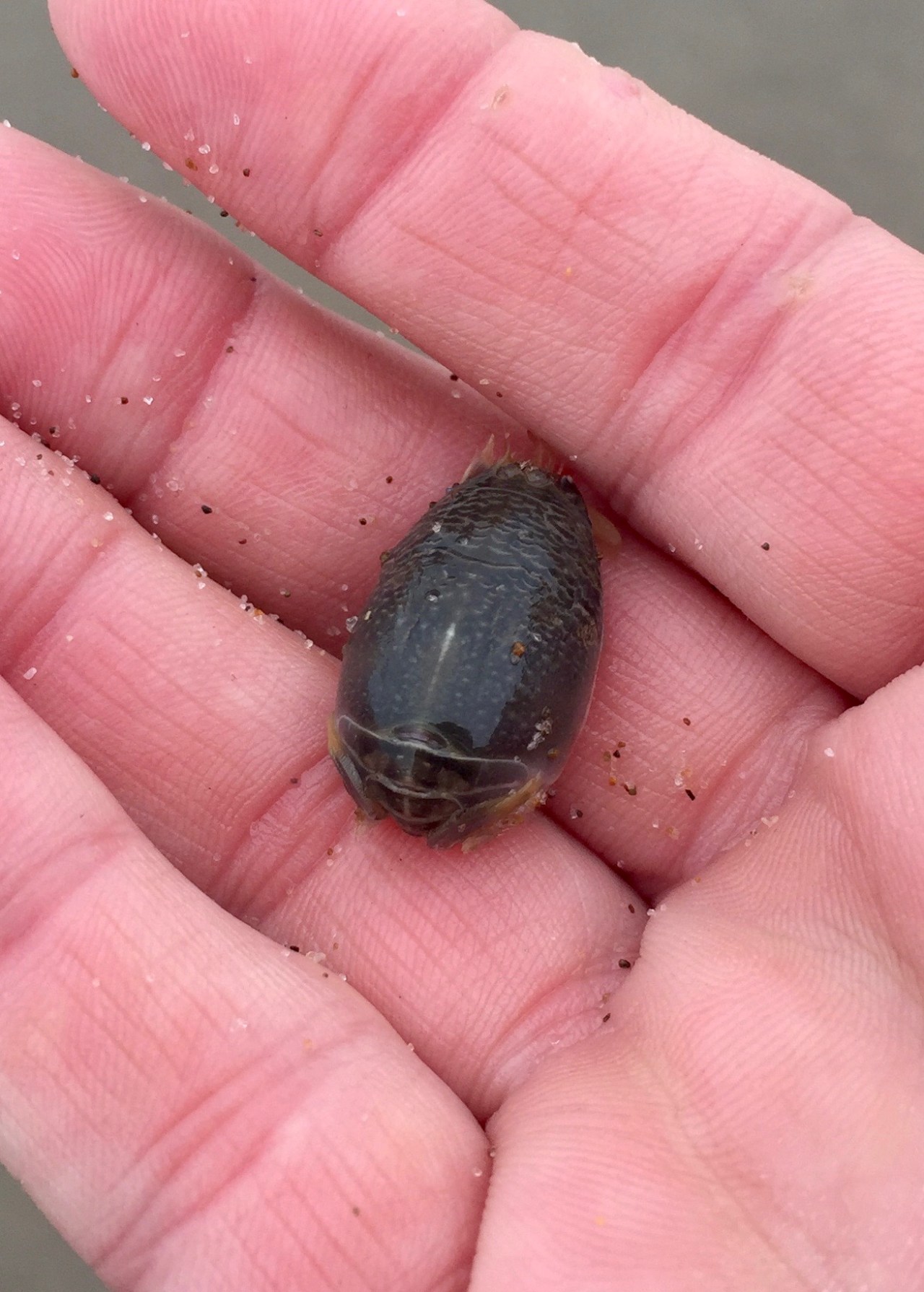
Meet the Pacific Sand Crab (Emerita analoga), a small crustacean that lives in the swash zone (you know, the section of sand in between the backbeach and the surf zone). Not an easy environment to survive in as the sand is constantly being tossed by the whims of the sea. Added to their challenge is the threat of predation from a number of shore birds, as well as Sea Otters and Barred Surfperch. Apparently, they’re delicious, with a shrimp-y or crab-like flavor.

I found it interesting that emerita means deserted (from the Latin eremus, from the Greek eremos). In Spanish the word evolved to mean hermit (one living in a deserted place). Did the sand crab earn this name because the swash zone is relatively uninhabited?

I discovered this little girl (the males are much smaller) during low tide. After her photo op I gently replaced her in the sand where she swiftly disappeared (backend first).

IMG_4061