Author Archives

Unknown's avatar

Erin

Coddiwompling through life, guided by my love of nature and insatiable curiosity.

Firsts

After the dismal rainy weather the day before I was greeted with a cloudy and mild morning, perfect for wandering the remains of the first permanent English settlement in North America. Speaking of firsts, I was the first visitor at the Jamestown National Historic Site that day.

In December 1606 three ships loaded with 144 men, boys, and provisions left London headed for the New World. The goal was to establish a colony to give England a foothold in between the Spanish and French land claims.

On May 14, 1607, after exploring the Chesapeake Bay a suitable location was finally selected, roughly 40 miles up a river (which they named after their king, James). As the three ships and their sailors returned to England, construction of a fort commenced.

The main prerequisites were that the land be defensible and unoccupied. The fort’s location on a bend in the river provided good sightlines. However, the land was in use by native people, though only seasonally. The Powhatan tribe did not have a permanent village there because, as the newcomers soon discovered, the swampy land wasn’t arable, there was a dearth of fresh drinking water, and the surrounding slack water bred hordes of mosquitoes.

Despite those hazards, and mainly through the largesse of the Powhatans, the colonists survived (unlike the earlier settlers at Roanoke which all mysteriously disappeared in the late 1580s). But survival wasn’t the only goal, the colony needed to find and cultivate materials for export.

Timber and forest products were in high demand in England, though cumbersome to transport. The settlers planted grapes for wine and mulberry trees for silkworms. They even tried glassblowing, mining, and shipbuilding. Of all their attempts, tobacco quickly became their most valuable commodity.

The downside of that cash crop? It was labor intensive. The economic woes in England provided a handy solution. Indentured servants were sent over by the boatload to work off their debts (or crimes, such as murder or even merely stealing a loaf of bread). Sadly, over 55% of them did not survive the harsh working conditions.

While ultimately a success story, I appreciated that the exhibits in the museum and on the grounds attempted to provide a balanced view. This first permanent colony produced a lot of firsts, not all of them good, such as the first plantations and the first slaves (with the arrival of stolen and enslaved Africans in 1619).

We are all fortunate that places such as this have been preserved and are still being studied. As Winston Churchill said in a 1948 speech to the British House of Commons, “Those that fail to learn from history are doomed to repeat it.”

Dismal, Indeed!

When mapping out my route from Raleigh to Chesapeake, Virginia I noticed the Great Dismal Swamp on the map. I didn’t know much about it but with a name like that who could resist checking it out? 

Midafternoon I pulled into the Dismal Swamp State Park in northern North Carolina. A relatively small park, it provides access to a narrow swath of land alongside the historic Dismal Swamp Canal. My first stop was the visitor center where I was pleasantly surprised by both the history and nature exhibits.  

Less than half of the original million acres of swampland remain, much of it drained for settlement and logging. The majority of the bald cypress trees that once towered over the murky water were cut down for building materials for the early colonists. As you might imagine, transporting the logs out of that morass was incredibly difficult.

During a visit in 1763, a 31-year-old gentleman farmer by the name of George Washington proposed building a canal in the landlocked area. Twenty years later work commenced. When it finally opened in 1805, the 22-mile long watery highway was a boon to commerce between North Carolina and Virginia.

Taking a hint from the name, I used up the last of my can of bug repellant before hitting the trails. Unfortunately, I was the only person on the boardwalk which meant I was the best food source around. The constant whine of mosquitoes I expected, but the fierce chomps of biting flies caught me off guard. Either I’m delicious or they were starving because they were relentless.

My curiosity wouldn’t be thwarted so I continued on to the path along the canal. In between swatting insects I pondered the struggle of the slaves who dug out the waterway over 12 long years. A testament to their hard work, it remains the oldest operating canal in the country, though these days it mostly just carries recreational boat traffic.

A fast-moving thunderstorm abruptly ended my explorations. A bit of a mixed blessing, I ended up soaking wet but at least the rain chased the insects away. The term dismal was given by early settlers to any swampy area, but its easy to see how this place earned the moniker Great Dismal Swamp. Dismal, indeed!

I ended my day with a brief trip to Virginia Beach, which I didn’t have much time to enjoy it as another big storm chased me off the sand. Some days are just like that…

Virginia Beach with Incoming Storm

Relaxing in Raleigh

Last week I took advantage of a lull in my schedule and headed up north to visit friends. My first stop was in Raleigh to spend time with Hector, one of my oldest friends (not that he’s ancient, I’ve just known him a long time).

The overcast skies made our outdoor wanderings quite enjoyable, definitely milder than my Florida temperatures. The time passed quickly with good conversations, tasty libations, and fantastic food.

It was a short visit, much to Gracie’s relief (I threw off her nap schedule and she was not amused). My next stop? An intriguing place with a wretched name: The Great Dismal Swamp.

Lovely Limpkins

As I mentioned the other day, I spent Saturday morning wandering the trails at nearby Boyd Hill Nature Preserve. Not only did the weather cooperate nicely but I was treated to some cool wildlife sightings (I shared the lazily floating alligator last time).

My favorite encounter occurred after I doubled back to my favorite trail. I heard an unusual amount of squeaking which made me think there was a baby bird nearby.

I didn’t expect to actually see the young one, as they are typically safely ensconced in a nest or tucked in foliage. So I was pleasantly surprised to find a Limpkin fledgling foraging with its mom.

Or more accurately, it was crying for food while following mom as she foraged. My boardwalk perch afforded mom a sense of safety as she continued to hunt and feed her loud hatchling.

I was so immersed in watching the pair that it took a few minutes before I spotted an older fledgling who was fending for itself a little further away. It was clearly larger than its sibling and probably a day or two older (mom lays an egg a day and they typically hatch in that order).

As you can tell from all the photos, it was difficult to tear myself away from the little family. Such a wonderful treat!

Feed Me! Limpkin Fledgling Follows Foraging Parent

Out for a Walk

This past Saturday I was enticed over to Boyd Hill Nature Preserve by a bird walk. I was surprised to see so many others had also decided to brave the elements that morning, there were over 20 of us.

We were fortunate to have overcast skies and a light breeze as we wandered the trails. Our final bird count was close to 30 species, which was decent considering it is practically Summer down here (unlike Winter birding which is fantastic). Even though we didn’t spot that many birds, there were plenty of other things to notice.

I peeled off from the group at the end in order to walk my favorite trail, which had not been part of our route. I’m glad I did as I was treated with a couple really cool sightings. The first treat I’ll share later (as it deserves its own post), the second was this juvenile alligator that was out for a float down a lazy river.

Bitty Blues

While pulling weeds in my front yard the other evening I spotted these little beetles. Roughly the size of a grain of rice (about 1/4″ long) I would’ve overlooked them if not for their gorgeous metallic blue-green color. Pesky weeds were forgotten as I dashed inside to grab my phone so I could take some photos in the last light of day.

A new species for me, I learned they are members of the Flea Beetle family (Altica spp.). Narrowing it down from there proved to be a bit more challenging. The definitive way to differentiate the species is to run their DNA. Since I don’t have a sequencer the next best way to distinguish them is to examine their internal genitalia, though that seemed mighty intrusive.

A less reliable, but field-friendly, method is to determine what host plant they are using as some species have strong preferences. Based on the plants in my yard, I believe these are Altica litigata, a species which happens to favor evening primrose.

Although they can fly, these beetles are good jumpers (much like fleas). In fact, they are so good at it that even their genus name references their skill (from the Greek word for jumper). Their strong hind legs enable them to jump long distances, probably to help them avoid predation.

Welcome to my yard, shiny ones!

Along the “Boat Building” River

Last week I drove deep into neighboring Pasco County to the Upper Pithlachascotee River Preserve, a little spot that just recently came across my radar. The river’s long name is Creek for “Boat Building” (pithlo=canoe and chaskita=to chop out). The once abundant cypress trees along the river attracted Seminoles who would hollow out the large tree trunks into canoes.

Cypress lumber was also prized by later settlers, who clearcut so many areas that few of the giants remain in Florida. This preserve was partially set aside to protect the largest remaining cypress tree in Pasco County and I was looking forward to seeing it.

I took the narrowing of the roads and growth of potholes as signs that I was getting closer. When I finally pulled in, it didn’t surprise me in the least to be the only car in the parking lot.

Low visitation can make for a more peaceful outing though there are some downsides; wildlife can be more skittish since they are unaccustomed to humans and trails tend to be overgrown since they are less frequently traveled. But the worst part, is all the dang spiderwebs! I coped by picking up a stick and waving it in front of me like I was casting spells. A behavior that I’m certain would have bemused fellow hikers, had I encountered any.

There were fewer than 5 miles of trails but there was still plenty for me to see along the way. A week earlier we had finally received some decent rainfall in the Tampa Bay area and plants had responded with showy displays. As a result, the place was buzzing with pollinators.

While I followed a bumblebee, a smaller version caught my eye because of its odd behavior. It wasn’t visiting flowers to fill the pollen baskets on its legs, instead it was clinging to a plant stem with something clenched in its grasp. It turned out to be a Bumblebee Robberfly, which as the name infers, is a mimic that preys on flying insects. The one I spotted was probably in the midst of injecting its catch with toxic saliva so it could then suck up the liquified innards. Yum!

I enjoyed a nice visit with a striking Eastern Rat Snake, a first for me. I admired the long, slender serpent as it slithered sinuously atop the duff. Since it lives in the forest, it didn’t surprise me to learn that it was also an agile climber.

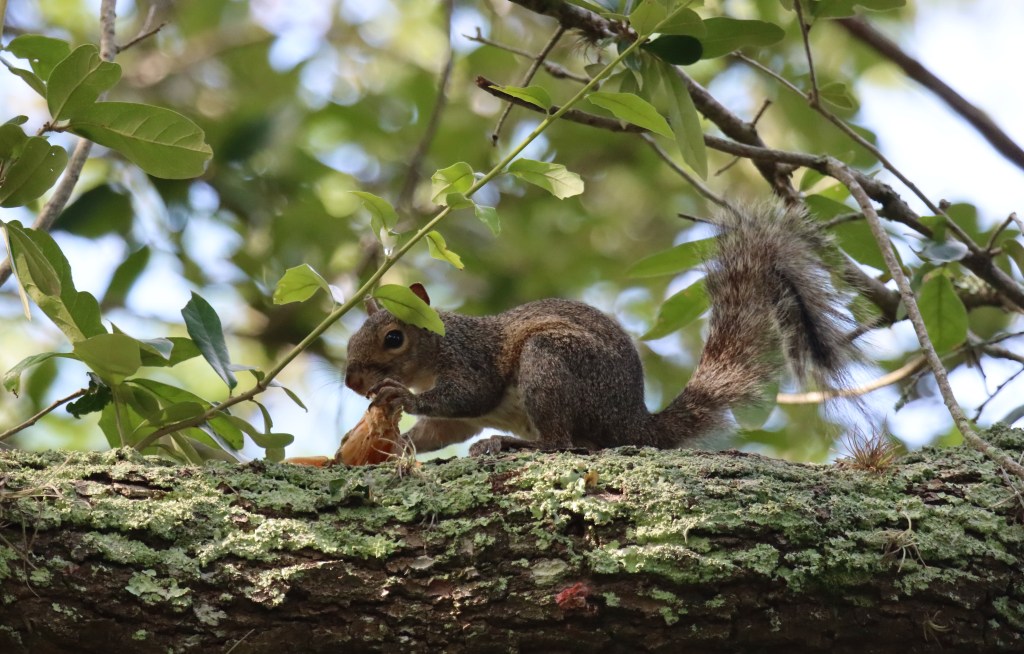
While a White-tailed Deer and an Eastern Cottontail chose not to pose for photos, an Eastern Grey Squirrel and a Gopher Tortoise didn’t seem to mind as they were both too busy chomping on their veggies.

I was pleased to discover some Reindeer Moss just off the trail. It is very sensitive to disturbance by humans, so there are precious few populations of it left in the state.

Unfortunately, I noted a couple invasive plant species had snuck into the preserve (looking at you Caeserweed and Air Potato Vine). Though happily, there weren’t very many specimens of either. I only spotted one invasive animal, a Wild Boar and it was deceased (which is my favorite kind of Wild Boar).

Sadly, last year’s hurricanes destroyed the section of boardwalk that leads to the large cypress so I didn’t get a chance to see it. I’m hopeful that it survived the storms. Even though I missed out on the giant cypress, it was still a lovely way to spend a warm, overcast day.

Feeling Fortunate

I took advantage of an overcast sky and paddled out to Shell Key this morning. While I was unloading my gear I started chatting with a couple that had driven all the way from Orlando to kayak here today. A good reminder of how fortunate I am to live so close to this treasure – it’s only a 20 minute drive from my house!

I took a slightly different route to the island, exploring several mangrove tunnels before landing in a new little bay just south of Irma’s Pass. Last year’s back-to-back hurricanes moved around an awful lot of trees and sand, creating a landing area just big enough for a few kayaks. I was out early so I had the place to myself.

I wandered the shore, looking for treasures and picking up trash. Thankfully, there wasn’t much of the latter. I didn’t linger too long once the breeze started to pick (as that can make for a less than enjoyable return trip).

Weaving between mangrove islands I came across a trio of dolphins fishing in the shallows. They were so intent on their prey that they allowed me to follow. I filmed them as I bobbed along and caught a snippet of “fish kicking”. It is a rather unusual technique where a dolphin circles a fish and spins quickly, whacking the fish out of the water with its tail. When the fish smacks down it is stunned which makes it an easy meal for the dolphin.

Researchers have only seen dolphins using this technique in two places, here in Tampa Bay as well as in the waters off New Zealand. A fun way to wrap up my morning on the water.

Dolphins, Fish Kicking (note the fish flying at the 7 second mark)

Hoots* in My Hood

I found this trio of Eastern Screech-Owls (Megascops asio) while on my way home from dinner last night. Given that it was cloudy with an obscured new moon I’m impressed that my phone managed to capture a somewhat decent photo of them.

Do not let their diminutive size fool you, they are ferocious hunters. While crickets, grasshoppers, and beetles make up a large part of their diet Screeches also prey on rodents. Mice are a favorite but they will even hunt down mammals that outweigh them such as rats, squirrels, and young rabbits. This behavior led early ornithologists to refer to them as “feathered wildcats”.

I’m thrilled to have them on patrol in my neighborhood!

* Yes, I’m aware this species doesn’t actually hoot (nor does it screech, but hey, I didn’t name it). Check out their cool sounds.

Paddling My Hood

When you have a day off and the temperature, tides, and wind are all favorable it would be a crime not to get out on the water. Luckily for me, I don’t have to travel far to launch since I can drop in right across the street from my house.

My kayaking rather confused Puff (one of the street kitties that adopted me after the hurricanes last Fall). He followed all the way down to the water and watched from the shade of a mangrove tree as I drifted away.

I paddled up Bear Creek for a bit, enjoying my neighborhood from a different perspective. There’s often a chance to spot manatees, dolphins, or even otters but this morning it was just me and the birds. Speaking of birds, the Mallard hen I photographed has an odd little addition to her brood, not entirely sure what kind of duck it is, but it’s hers now.

A quick paddle under the Gulfport Boulevard bridge and I entered the Boca Ciega Bay Aquatic Preserve. At this point I had several options; south to St. Pete Beach, east to Gulfport, or north to Treasure Island. Since I knew the day would heat up quickly, I kept it short and paddled out to Jack’s Island in the middle of the bay.

This small crescent of a key is supposedly privately owned but the owners allow day use. I had the beach to myself for most of my visit, it was so very relaxing. Just what I needed since I had a house project waiting for me that I was not looking forward to (more about that soon).