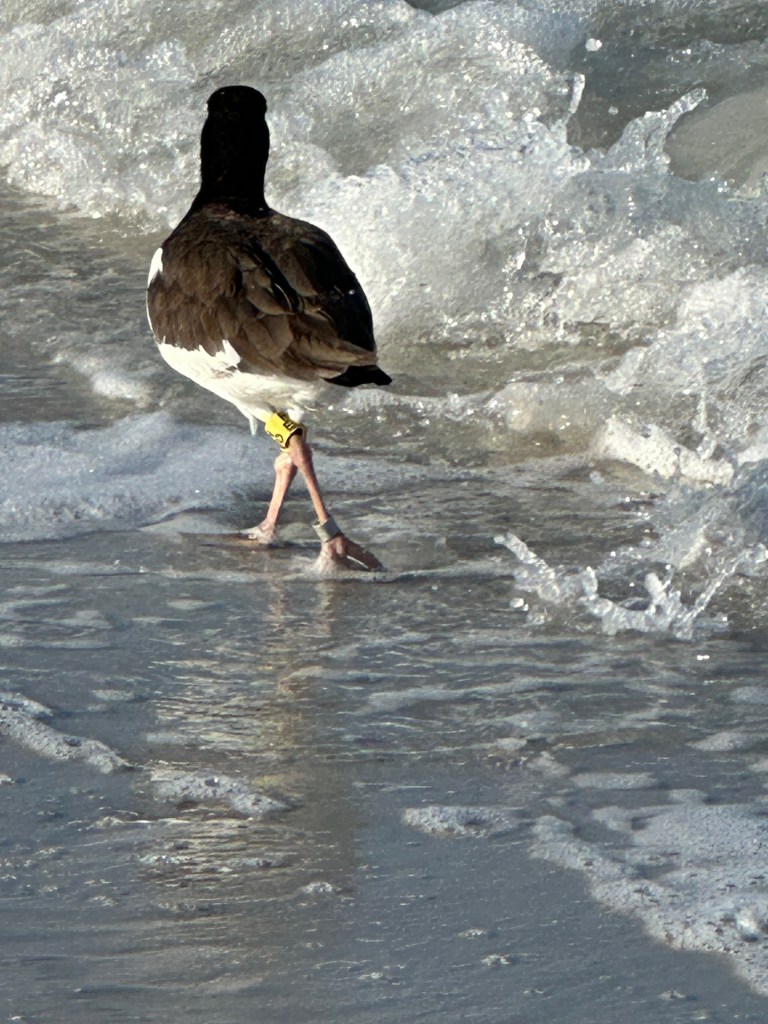


My friend Hector was just recently in town for a couple days so, of course, I drug him out to my favorite place, Treasure Island, a couple times. While Hector and I were walking the beach Monday morning I noted this American Oystercatcher.
They are striking avians on their own but I was particularly fascinated by this one since it was banded. After a bit of online digging, I learned that a research study started back in 2013 to assess and monitor the welfare of this species. The overall number of these large and showy shorebirds has declined and, if this continues unabated, they could soon be listed as a Threatened Species.
Thankfully, the bird was tolerant and allowed me to capture a few photos with my phone. They were good enough that I was able to determine the “triangular” code of the color bands on the bird’s upper legs (the metal band on the lower leg is only meant to be read when the bird is recaptured or found deceased).
I used this information to file a band sighting report online with the American Oystercatcher Working Group. I had hoped to learn more about “my bird” from the data set collected when it was originally banded (age, sex, etc.) but I couldn’t find that anywhere on the website. I was at least able to determine that it was banded up in Massachusetts within the last ten years.
Here’s hoping this bird (and the rest of the species) live long and prosper!
 3rin's View...
You’re such a band groupie! 😉
LikeLiked by 1 person
😂
LikeLike